Site policy
Commercial use and copyright basics
A vendor’s licence is not the same as a copyright. This page summarises official U.S. Copyright Office guidance and official tool terms we actually opened on 18 November 2026. It is general information, not legal advice, and it is not a substitute for reading the current official terms or taking advice for your situation.
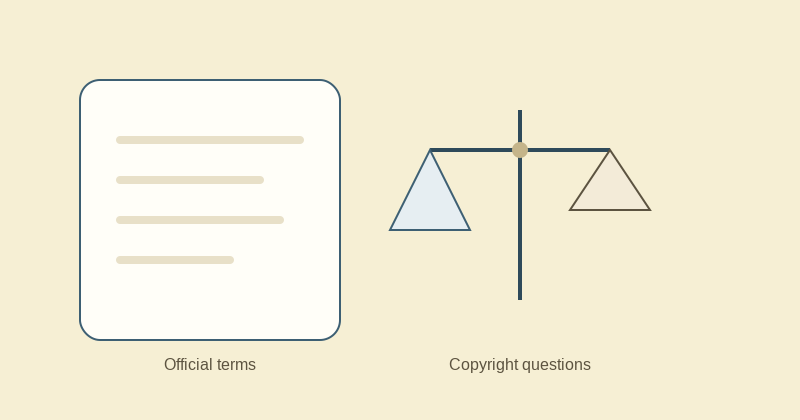
This is not legal advice
Nothing on this site is legal advice, consumer-rights advice, or a determination of your rights in any country. Official vendor terms can change. Official copyright guidance can be updated. If a project matters — a campaign, a product line, a book, a trademark filing — read the current official terms and get advice from a qualified professional who can look at your facts.
Two different questions
First: what does the tool’s official contract or FAQ say you may do with an image (personal use, commercial use, public gallery, ownership after you cancel)? That is a licence or contract question between you and the vendor, subject to the wording and to third-party rights.
Second: does copyright law actually protect that image, or the parts of it a human authored? Official U.S. Copyright Office guidance treats those as separate issues. A vendor can say “you own the output” while U.S. guidance still says that purely AI-generated material is not protected by copyright. Both statements can appear in official sources at the same time. This page quotes those official sources; it does not pick a winner for your project.
What official U.S. Copyright Office guidance said
The U.S. Copyright Office published Copyright Registration Guidance: Works Containing Material Generated by Artificial Intelligence on 16 March 2023 (Federal Register Vol. 88, No. 51, 37 CFR Part 202). The guidance states that copyright protection in the United States requires human authorship. It describes a 2018 application for a work “autonomously created by a computer algorithm” that was refused, and a February 2023 example: a graphic novel with human-authored text and Midjourney images was a copyrightable work as a whole, but the individual images themselves could not be protected.
The 2023 guidance also states that if traditional elements of authorship are produced by a machine — for example, when a person gives a prompt and the AI system produces a complex visual work — the material is not the product of human authorship and must be disclaimed. A work may still contain sufficient human authorship, such as creative selection, coordination or arrangement, or modifications that meet the standard; copyright then protects only the human-authored aspects. Applicants should disclose more-than-de-minimis AI-generated material and describe the human author’s contribution. The guidance says not to list the AI or company as author or co-author merely for use of the tool.
The Office’s later report, Copyright and Artificial Intelligence, Part 2: Copyrightability (29 January 2025), includes these conclusions, among others: questions can be resolved under existing law; using AI as an assistive tool does not bar protection; copyright protects original human expression even if the work also includes AI-generated material; copyright does not extend to purely AI-generated material, or material where there is insufficient human control over the expressive elements; whether human contributions are sufficient must be analysed case by case; “Based on the functioning of current generally available technology, prompts do not alone provide sufficient control.” Human authors may have copyright in works of authorship that are perceptible in AI-generated outputs, and in the creative selection, coordination or arrangement of material, or in creative modifications.
The official hub for this work is copyright.gov/ai. The 2023 guidance is also published in the Federal Register. This summary covers U.S. federal copyright guidance we opened. It does not describe the law of Germany, the EU, or any other country.
Sources for this section
- U.S. Copyright Office AI initiative hub. Checked on 2026-11-18.
- Copyright Registration Guidance (PDF, 16 March 2023). Checked on 2026-11-18.
- Federal Register publication of the 2023 guidance. Checked on 2026-11-18.
- Copyright and Artificial Intelligence, Part 2: Copyrightability (PDF, 29 January 2025). Checked on 2026-11-18.
What official vendor terms we opened actually said
These are contract or FAQ statements from official pages, not copyright determinations:
Midjourney’s official commercial-use article says you own the images and videos you create, even after cancelling, with exceptions: upscales of another user’s image belong to the original creator; and if you are part of a business grossing more than $1,000,000 USD a year, you need a Pro or Mega plan to use your images commercially for your company. The official Terms of Service (effective 27 May 2026) state that companies or employees of companies with more than $1,000,000 USD a year in revenue must be subscribed to Pro or Mega to own their Assets. Midjourney says it cannot offer guidance on copyright matters.
OpenAI’s official Terms of Use (effective 1 January 2026) state that, as between you and OpenAI and to the extent permitted by applicable law, you own the Output, and OpenAI assigns its right, title and interest, if any, in Output to you. Output may not be unique. You may not represent that Output was human-generated when it was not.
Adobe’s official generative credits FAQ states that for features without the beta label, you can use Adobe Firefly-generated outputs in commercial projects. Beta outputs may be used commercially unless the product says otherwise; for eligible teams and enterprise customers, beta outputs are not indemnified.
Recraft’s official pricing FAQ states that images generated on the Free plan are owned by Recraft, are publicly visible, and are not licensed for commercial use. Paid plans grant full ownership and commercial rights for images generated while subscribed, and those rights persist after cancellation.
Leonardo.Ai’s official pricing FAQ states that paid subscribers retain full ownership and intellectual property rights and can use creations for commercial projects. On the Free tier, Leonardo.Ai owns rights to the images and grants a non-exclusive, royalty-free licence to use generated content for commercial purposes.
Microsoft’s official Designer FAQ states that Designer is licensed for personal, non-commercial use with a Microsoft account.
We did not successfully open official commercial-ownership terms for Ideogram, Gemini or FLUX in this build, and we did not extract the full Magnific/Freepik commercial-use FAQ answer. Those reviews say so instead of guessing. Always open the current official terms yourself.
A practical checklist — still not advice
- Read the current official terms and any commercial-use FAQ for the exact plan you are on, including free versus paid differences.
- Check whether images are public or remixable by default (for example, official Midjourney and Recraft Free wording).
- Do not assume a vendor “you own the output” sentence means the image is copyrightable in the United States. Official U.S. guidance says purely AI-generated material is not protected, and that prompts alone do not provide sufficient control.
- If you plan to register a work in the United States, read the official 2023 guidance on disclosing more-than-de-minimis AI-generated material.
- Consider labelling and disclosure separately — see the AI image labelling and disclosure guide.
- Get advice for your country and your use. This page is a map to official sources, not a decision for your project.
Frequently asked questions
If Midjourney or OpenAI says I own the image, is it copyrighted?
Not automatically, according to official U.S. Copyright Office guidance we opened. Vendor terms describe the contract between you and the vendor. Official U.S. guidance says copyright does not extend to purely AI-generated material, and that prompts alone do not provide sufficient control. This is not legal advice.
Can I use a free-plan image in a client campaign?
It depends on the official terms for that plan. Official Recraft wording says Free-plan images are not licensed for commercial use. Official Leonardo wording grants a non-exclusive royalty-free commercial licence on the Free tier while Leonardo.Ai owns the rights. Official Microsoft Designer FAQ wording is personal and non-commercial. Read the current official terms. This is not legal advice.
Does this page apply outside the United States?
The Copyright Office material we opened is U.S. federal guidance. Vendor terms may apply according to their own governing-law clauses. We have not summarised the copyright law of other countries on this page.
Official sources checked for this page
- U.S. Copyright Office AI hub. Checked on 2026-11-18.
- 2023 Copyright Registration Guidance (PDF). Checked on 2026-11-18.
- Federal Register, 16 March 2023. Checked on 2026-11-18.
- Copyright Office Part 2 report (PDF, 29 January 2025). Checked on 2026-11-18.
- Midjourney commercial-use article. Checked on 2026-11-18.
- Midjourney Terms of Service (effective 27 May 2026). Checked on 2026-11-18.
- OpenAI Terms of Use (effective 1 January 2026). Checked on 2026-11-18.
- Adobe Firefly generative credits FAQ. Checked on 2026-11-18.
- Recraft official pricing. Checked on 2026-11-18.
- Leonardo.Ai official pricing. Checked on 2026-11-18.
- Microsoft Designer official FAQ. Checked on 2026-11-18.